AI Agents for E-commerce sellers
How I led the UX for Olist AI Agents — a suite of intelligent assistants that cut repetitive work by 45% for small and medium e-commerce businesses across Brazil.
PROBLEM
Designing AI agents that sellers actually trust
Brazilian SMB sellers operate across multiple marketplaces simultaneously — Mercado Livre, Amazon, Magalu, and more — while managing inventory, customer messages, fiscal documents, and logistics largely on their own. It's an enormous operational surface area for a small team, or often a team of one.
When I started discovery, I expected to find frustrated users asking for more automation. What I actually found was more nuanced: sellers weren't just overwhelmed by volume. they were exhausted by the mental overhead of constant context-switching between disconnected tools, and they were deeply afraid of making mistakes at scale.
I'd rather answer 50 messages myself than have a bot send the wrong thing to a customer and lose the sale.
That fear wasn't irrational. It was a signal. The design challenge wasn't simply "how do we automate tasks", it was "how do we build a system that earns trust gradually, gives sellers real control, and still delivers meaningful time savings?"
Research & Discovery
Four findings that changed the direction
I grounded the discovery phase in semi-structured interviews with SMB sellers, analysis of support logs, behavioral data from the Olist ERP platform, and benchmarking of existing automation tools.
Across all of it, four patterns kept surfacing:
Repetition, not complexity, was the real drain. Sellers weren't struggling with hard decisions — they were drowning in the same simple tasks repeated dozens of times a day. Order status. Shipping questions. Price updates. The cognitive load was death by a thousand small things.
Trust is the product. Most users had tried some form of automation before and had a bad experience — a wrong message sent, a price updated incorrectly, a rule that fired at the wrong time. Their default was skepticism, and that skepticism was completely reasonable.
Control, not capability, drove adoption. Sellers didn't need AI to be smarter — they needed to feel like they could override it, pause it, and understand what it was doing. Visibility and reversibility mattered more than raw intelligence.
Setup friction kills momentum. Sellers are not technical users. Any system that required configuration, rule-building, or code before delivering value was going to be abandoned. Time-to- value had to be measured in minutes, not hours.
From blank canvas to a system sellers could grow into
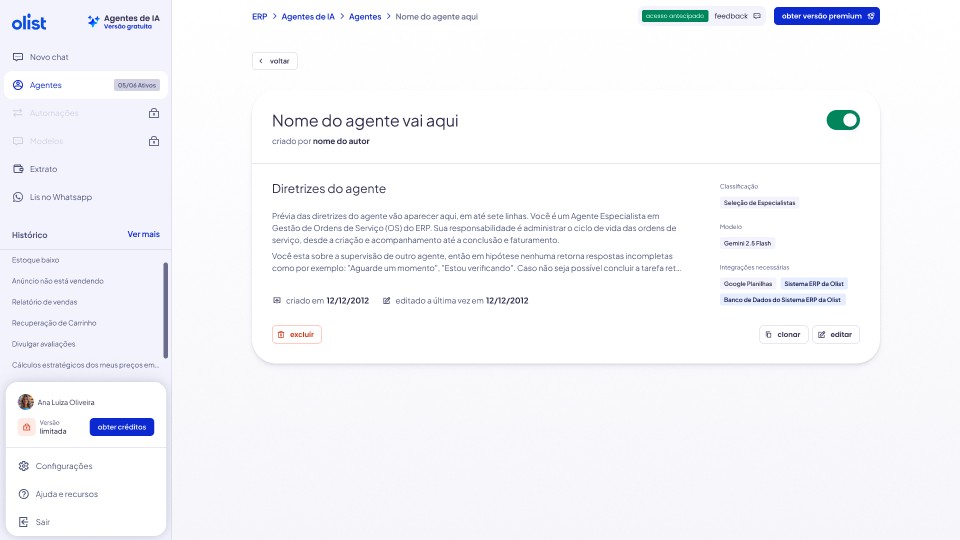
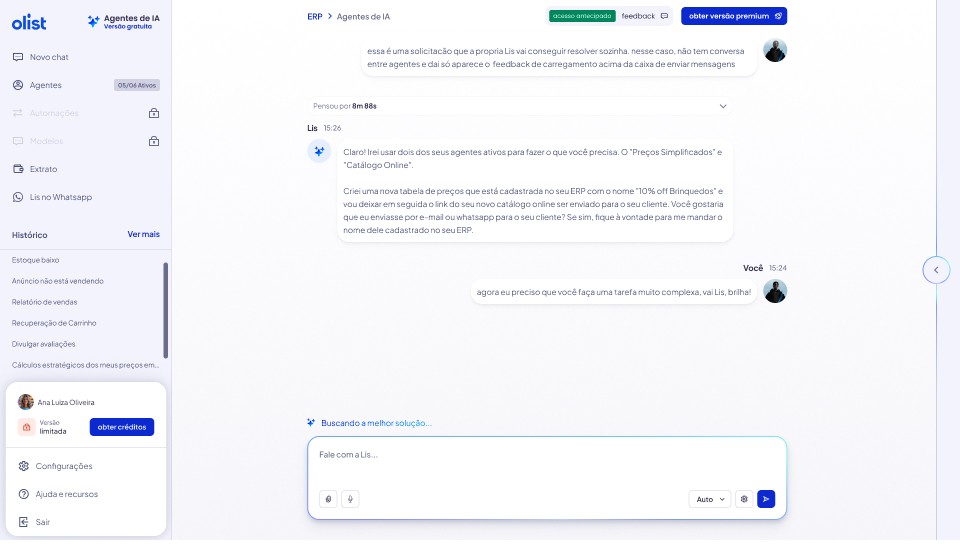
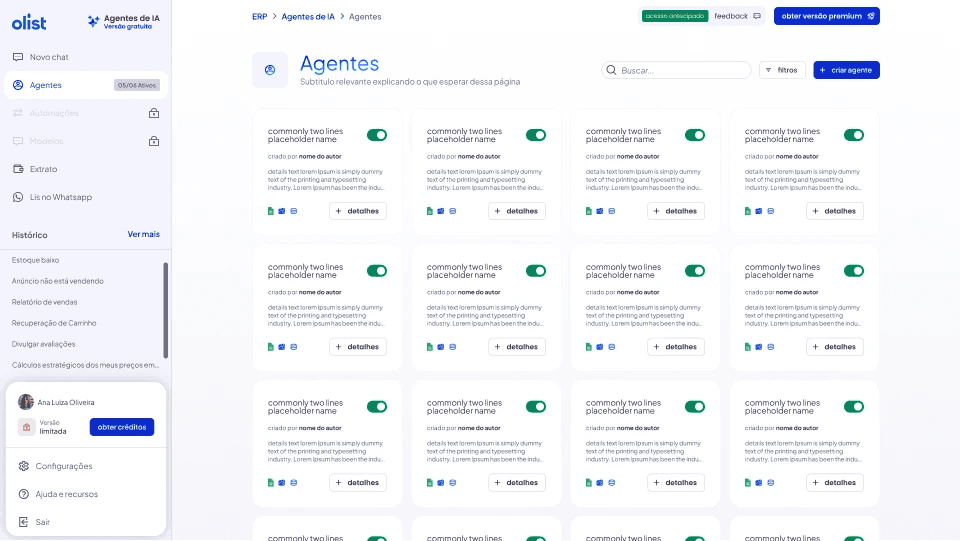
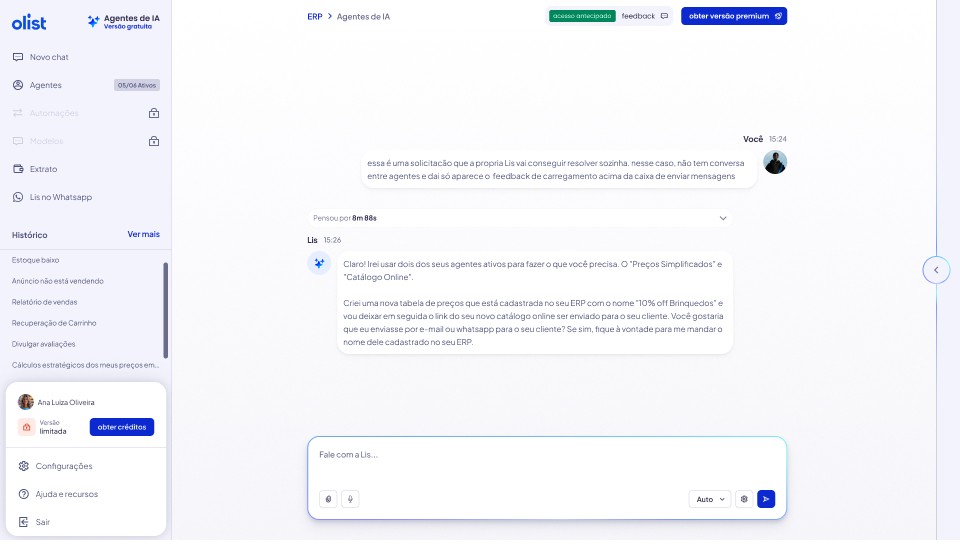
The central concept I landed on was modular AI agents — individual assistants with specific roles, activated with a single click, and observable in real time. At the center of it all was Lis, the conversational supervisor that interprets natural language commands and routes them to the right specialist agent. This architecture mattered for UX reasons as much as technical ones. Giving each agent a defined purpose meant users could understand the system at a glance. "Lis handles the conversation. The stock agent watches my inventory. The orders agent processes purchases." Mental models form faster when things have clear, named roles.
KEY DESIGN DECISIONS
Transparency over magic: Every AI action is logged, readable, and explainable. Sellers can see exactly what the agent did and why — not just that something happened.
Pre-configured templates as the default: No blank states. Every new user lands with agents ready to be activated, not a form asking them to build from scratch. First value in under two minutes.
Human-in-the-loop by design: Critical automations — anything touching a customer message or fiscal document — include a confirmation step. We never optimized away the pause that builds trust.
Progressive complexity: The interface starts simple and reveals depth over time. Beginners activate pre-built agents. Power users compose custom ones and share them with the community.
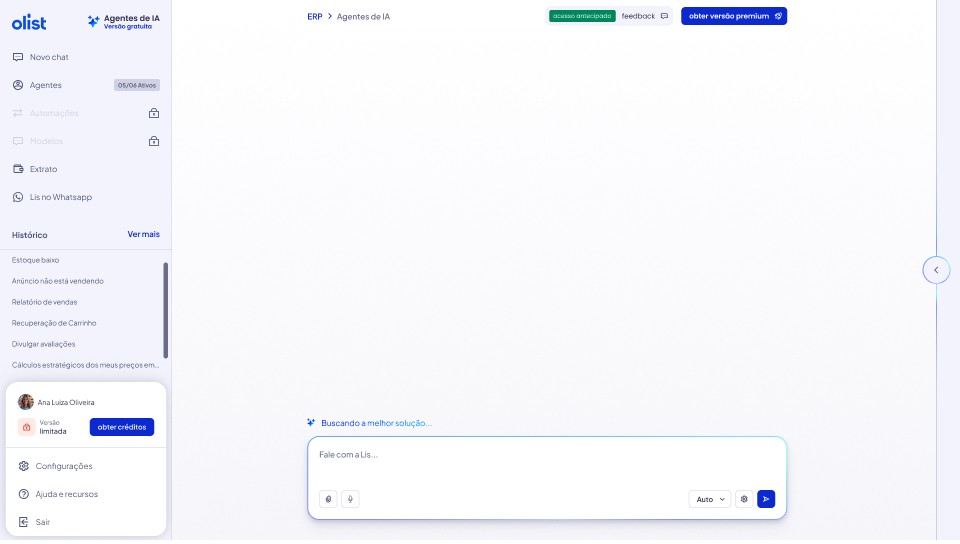
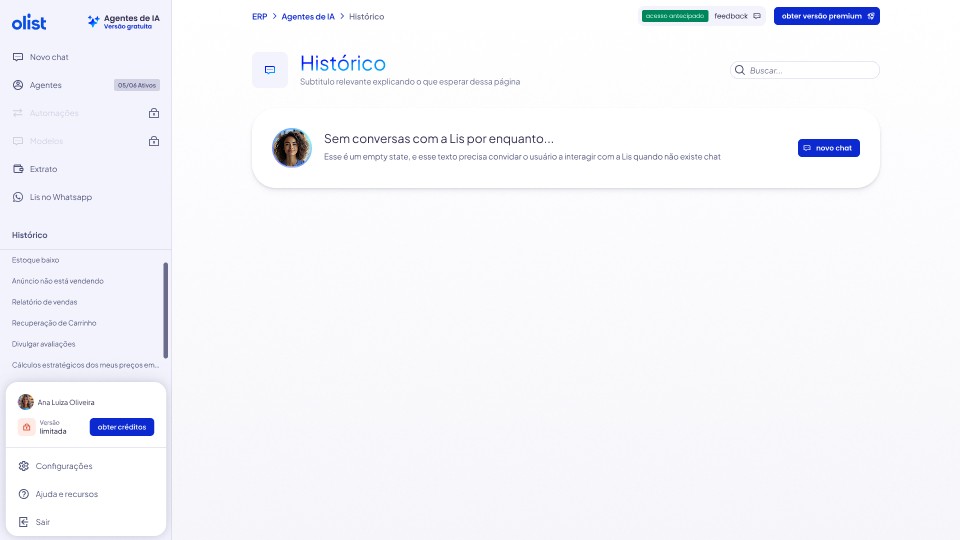
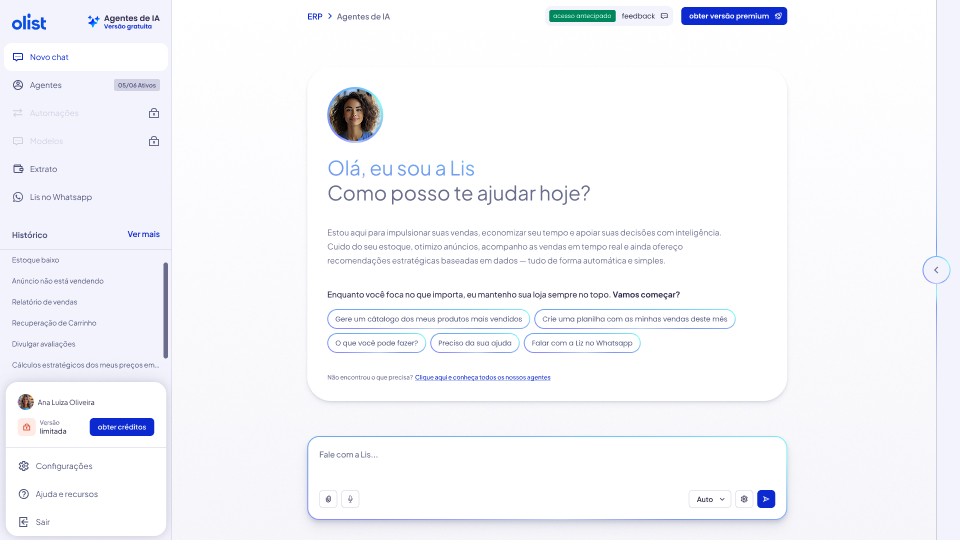
One of the hardest design problems was the empty state — what a user sees before their first conversation with Lis. The instinct is to leave it minimal. But we found in testing that an empty conversational interface felt intimidating and unclear. I redesigned the empty state to feel like an invitation: example prompts, suggested first actions, and Lis's avatar present and ready. Small change, significant impact on activation rates.
Onboarding was another critical battleground. Users with low technical literacy needed to reach a "this is working" moment before they'd invest further. I designed a guided first-access flow that walked sellers through activating their first agent in three steps — plain-language explanations at every point, no AI jargon, no configuration screens, no learning curve before the payoff.
Usability testing
What we got right, and what we fixed
I ran remote usability sessions with SMB sellers across different business sizes and technical comfort levels. Each session used task-based scenarios: activate an agent, review what it did, adjust its behavior, respond to an edge case. We also ran A/B tests on onboarding variations.The single most consistent finding: users hesitated when they didn't understand an AI decision. Not because they distrusted Lis — but because the interface didn't give them enough to go on. A message like "Order updated" was less reassuring than "Lis updated the shipping status for order #4821 because the carrier confirmed delivery." Context is confidence.
From that insight, I added an "explain this action" feature throughout the activity feed — a lightweight disclosure that surfaces the reasoning behind each automated step. We also simplified the language across the entire product, removing any phrasing that assumed technical familiarity. Words like "workflow trigger" became "what makes this start." Task completion rates improved, hesitation dropped, and users began exploring additional agents within the same session rather than stopping after the first one.
What I learned
Automation only works when users trust it — and trust is designed, not assumed
Olist AI Agents reached thousands of Brazilian sellers and deliveredmeasurable gains: nearly half the time previously lost to repetitive tasks, response times cut by more than half, and meaningful improvements in satisfaction scores. But more than the numbers, this project sharpened something I now think about in every AI product I touch.
The instinct when designing AI features is to optimize for capability — to make the AI do more, faster, more autonomously. That's often the wrong problem. The real challenge is designing the relationship between a user and a system they don't yet understand. That means investing in transparency, building reversibility into every critical action, and resisting the urge to hide complexity behind a "just trust us" interface.
I also learned how much language matters in AI products. The difference between a user who felt in control and one who felt anxious often came down to a single line of copy — whether an action was explained or just reported. UX writing and interaction design are inseparable in these contexts.
If I returned to this project, I'd push further on analytics — giving sellers a clear view of what AI is saving them, in hours and in revenue, so the value stays legible over time. And I'd invest more in the custom agent builder: how do you give non-technical users the tools to create something powerful without exposing all the complexity underneath? That's a design problem I'd genuinely love to solve.
*The metrics for this project are still under NDA
—%
time spent on repetitive operational tasks
—%
average customer response time
—%
increase in automation adoption rate
—%
improvement in seller satisfaction (CSAT)